Publishing Theory, Strategy & Brand Management (13)
Defining Brand Archetypes: The Magazine Personality
Giving your brand human character and psychological aura using Carl Jung's archetype theory.
What will you find in this guide?
- Adapt Carl Jung's 12 psychological archetypes to construct a distinctive publishing identity.
- Analyze the editorial manifestations of The Sage, The Explorer, The Outlaw, and The Ruler.
- Maintain archetype consistency across cover art, typography, and writer curation.

Brand Archetypes: Which Persona Does Your Publication Inhabit?
Readers do not merely buy pages; they align with archetypes, attitudes, and mythologies. If your magazine stepped into a room, what emotional frequency would it project? The erudite polymath? The intrepid globetrotter? Or the unapologetic cultural rebel?
Carl Jung's archetypal psychology provides the ultimate compass for creating cohesive, unforgettable editorial personality.
The Four Dominant Publishing Archetypes
-
THE SAGE:
- Drive: Truth, analytical clarity, philosophical depth.
- Voice: Authoritative, measured, erudite, objective.
- Benchmarks: The Economist, National Geographic, The Atlantic.
- Visual Language: Classical serifs, generous margins, dignified navy and slate palettes.
-
THE EXPLORER:
- Drive: Discovery, non-linear journeys, authentic cultural frontiers.
- Voice: Evocative, curious, expansive, wanderlust-infused.
- Benchmarks: Outside Magazine, Monocle, Cereal.
- Visual Language: Expansive landscape photography, tactile organic palettes, kinetic grids.
-
THE OUTLAW (The Rebel):
- Drive: Challenging complacency, demolishing orthodoxy, raw unvarnished truth.
- Voice: Provocative, visceral, urgent, counter-cultural.
- Benchmarks: Vice, 1970s DIY punk fanzines, early Rolling Stone.
- Visual Language: High-contrast monochromes, distressed textures, experimental anti-design.
-
THE RULER (The Sovereign):
- Drive: Prestige, high craftsmanship, aristocratic refinement, authority.
- Voice: Elite, polished, immaculate, aspirational.
- Benchmarks: Vogue, Robb Report, Architectural Digest.
- Visual Language: High-contrast Didone serifs (Bodoni, Didot), minimalist luxury aesthetics.
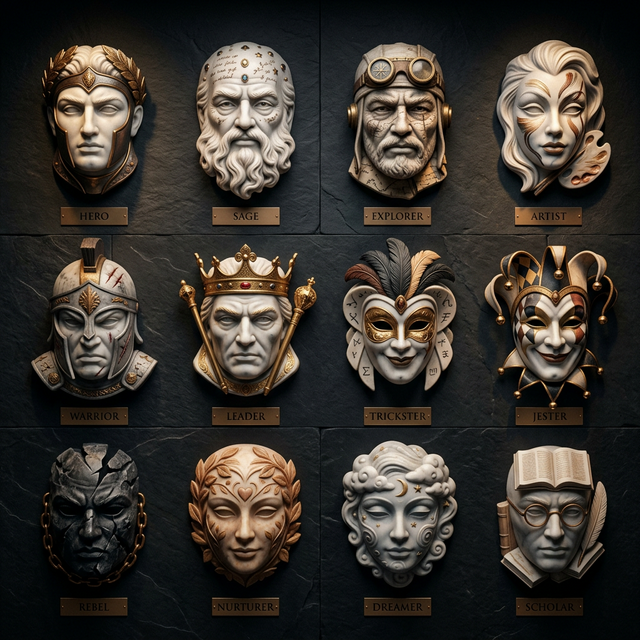
The Archetype Test: Answer this diagnostic question: "How should your reader feel after closing the back cover?"
- Intellectually equipped and wiser? (The Sage)
- Liberated to explore uncharted territory? (The Explorer)
- Provoked to challenge consensus? (The Outlaw)
- Part of an elevated aesthetic elite? (The Ruler)
Key Takeaways
Readers do not buy dry data; they bond with the psychological persona projected by a cohesive archetype.
The Sage delivers intellectual rigor, while The Outlaw challenges complacency with unapologetic courage.
Archetypal consistency creates subconscious trust, fierce loyalty, and enduring prestige.